ball dahlia varieties
Best Ball Dahlia Varieties to Grow and Buy This Season
Eight ball dahlia varieties worth garden space this year, compared by color, size, and vase life, with links to growers who actually have tubers to sell.
Published 7/9/2026
Share this post
Help more growers, small farms, and dahlia collectors find it.
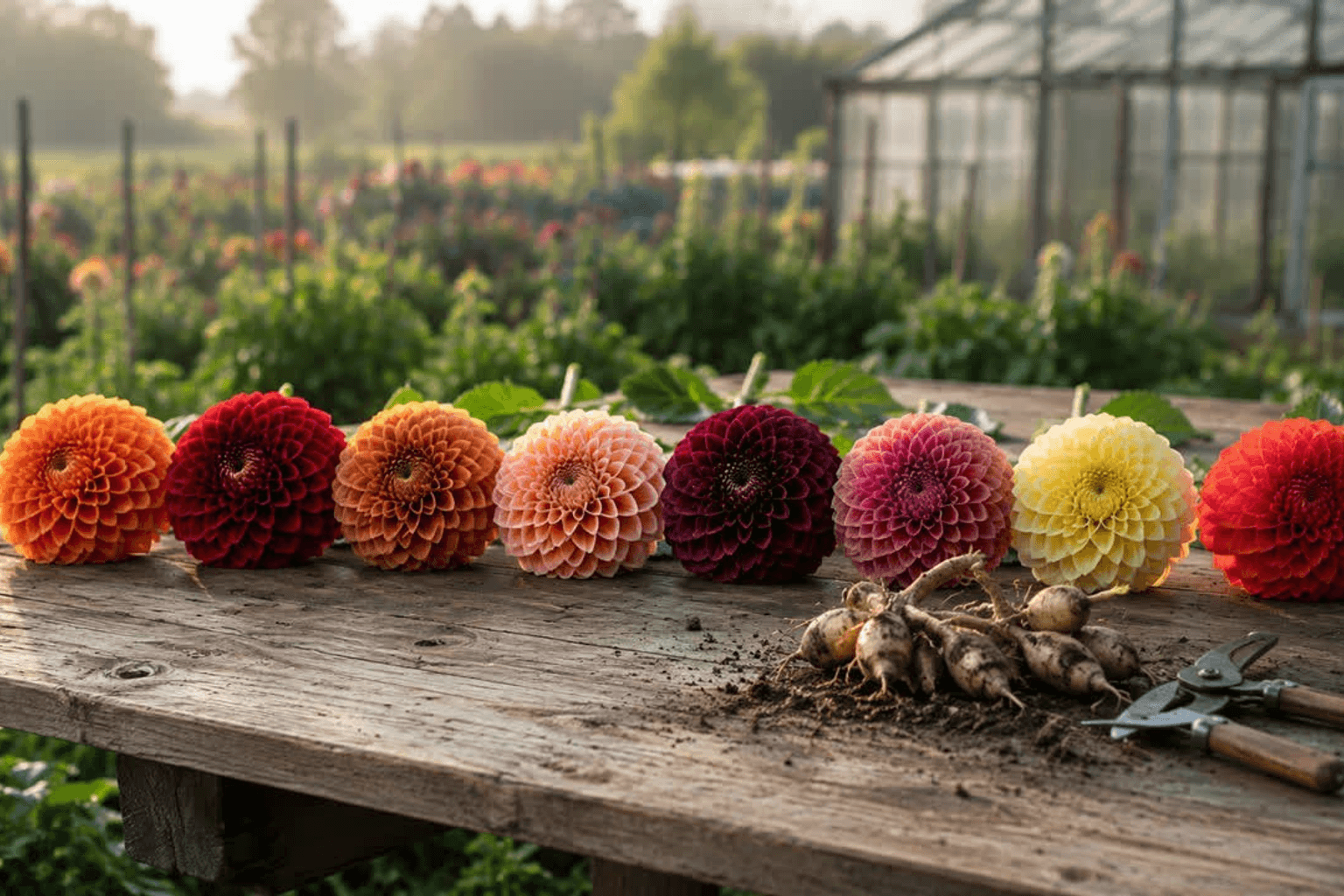
If you want ball dahlia varieties that hold their shape in the garden and in the vase, this list will save you a season of trial and error. These eight cultivars earn their spot on real cut-flower tables year after year, and you can compare each one and find small growers selling tubers of most of them right here on The Dahlia Hub.
What makes a ball dahlia different
A ball form dahlia is exactly what the name promises: a fully double, nearly spherical bloom built from tightly rolled florets that spiral toward the center with almost mechanical precision. The American Dahlia Society classifies most of them in the 4 to 6 inch BB class, with some pushing into B territory.
That geometry is not just pretty. It is structural. The rolled florets shed rain instead of trapping it, resist bruising in transport, and keep their shape for five to seven days in the vase, which is why florists reach for them before almost any other form. If you have ever watched a dinnerplate collapse two days after cutting, you will understand why growers who sell stems keep at least a third of their rows in ball and pompon types.
Balls also tend to produce long, straight stems and heavy flushes from midsummer to frost. For a hobby grower deciding where limited bed space goes, they are one of the highest-return choices you can make.
The 8 best ball dahlia varieties for gardens and bouquets
Every variety below is listed in our catalog with its full form, size, and color profile, so you can click through, compare, and add the ones you love to your wishlist.
1. Jomanda
Jomanda is the burnt-orange classic from Dutch breeder Cor Geerlings, introduced in 1996 and still outselling varieties thirty years younger. The color sits between terracotta and salmon depending on your soil and light, and it pairs beautifully with fall wedding palettes. Strong stems, reliable tuber production, and a bloom that ships well make it a staple for sellers too.
2. Cornel
Cornel is the benchmark red ball, another Geerlings introduction from 1994. The deep crimson blooms are so uniform that exhibitors use them to learn what a perfect ball should look like. It is vigorous, healthy, and famously true-to-name, which matters when you are buying from a new source and want exactly what the photo shows.
3. Cornel Bronze
Cornel Bronze is the amber sport of Cornel and arguably the most requested ball dahlia in the cut-flower trade right now. Same disciplined form, same stem quality, but in a glowing caramel orange that photographers adore. Tubers sell out early almost every year, so if you see a listing in early spring, do not wait.
4. Linda's Baby
Linda's Baby produces soft peachy-pink blooms on tall, productive plants, and it has become a wedding-work essential since its 2004 introduction. Growers love it because one clump divides generously, and buyers love it because the color flatters every bouquet it touches. If you only add one pink this year, this is the one.
5. Ivanetti
Ivanetti brings the moody side of the spectrum: rich plum-purple balls on dark stems that hold their color instead of fading in summer heat. It reads almost black in low evening light, which makes it a favorite for dramatic arrangements and late-season markets.
6. Jowey Winnie
Jowey Winnie comes from the Belgian Jowey line and layers dusty rose over a darker base, so every bloom carries its own gradient. It is one of those varieties that looks better in person than in photos, and repeat buyers tend to order it in multiples once they have grown it.
7. Blyton Softer Gleam
Blyton Softer Gleam is the yellow that converts yellow skeptics. The soft butter tones blend into cream at the edges, sidestepping the harshness that keeps many yellows out of bouquets. Bred by Les Stothard in 2003, it is compact, tidy, and remarkably productive for its size.
8. Kenora Fireball
Kenora Fireball is a small, intense red that sits between a ball and a pompon in feel, with a flame-bright color that carries across a market stall. It is harder to find than the others on this list, which makes it exactly the kind of variety worth tracking on a wishlist so you get notified when a grower lists it.
Already picturing three of these in your garden? Create a free account on The Dahlia Hub to build your wishlist and get matched with growers who have tubers available. Register free and start comparing varieties side by side.
How to choose the best ball dahlias for your garden
If you are choosing among the best ball dahlias for a first order, think in terms of jobs rather than colors. For bouquet work, prioritize stem length and vase life: Cornel Bronze, Linda's Baby, and Jowey Winnie are the safest bets. For garden presence, Ivanetti and Jomanda carry deeper, richer tones that read well from a distance. For exhibition practice, Cornel remains the teaching standard.
A practical example: a grower cutting for a Saturday market might plant six Cornel Bronze, four Linda's Baby, and two Ivanetti. That mix yields a warm-to-dark range that covers most bouquet recipes from August to frost, with enough surplus to sell straight bunches of each.
Check the size class before you buy. Most balls are BB, around 4 to 6 inches, but miniature balls run smaller and read very differently in an arrangement. Each variety page in our catalog shows the classification, bloom size, and whether the variety is suited for cutting, so you can compare before committing bed space.
Where to find ball dahlias for sale
Finding ball dahlias for sale is easy in theory and frustrating in practice. Big-box tubers are often mislabeled, and popular varieties like Cornel Bronze vanish from small farm shops within days of a spring shop update. The growers who breed and divide these varieties carefully are usually small, seasonal, and scattered across dozens of individual websites.
That is the exact problem The Dahlia Hub exists to solve. You can browse all ball dahlias in one place, see which have active listings, and meet the growers behind each one. Every listing connects to a real grower storefront, so you know who divided your tubers and can ask questions before you order. Many of our sellers are hobby growers with small stock counts, which means varieties are true-to-name and freshly divided, but it also means acting fast when something rare appears.
If you are still deciding what else belongs in your order, our guide to the best dahlias for cut flowers pairs well with this list.
Frequently asked questions
Are ball dahlias good for beginners?
Yes, and arguably the best form to start with. The blooms shrug off weather that shreds larger forms, the plants branch naturally with basic pinching, and the tubers store well over winter. Varieties like Jomanda and Cornel are forgiving enough for a first season and rewarding enough to keep forever.
How big do ball dahlia blooms get?
Most ball dahlia varieties bloom in the 4 to 6 inch range, the BB classification. A few reach the 6 to 8 inch B class, while miniature balls stay under 4 inches. They sit in the sweet spot between delicate pompons and oversized dinnerplates.
How long do ball dahlias last in a vase?
Cut at the right stage, most hold five to seven days, which is on the long end for dahlias. Cut when the blooms are three-quarters open, early in the morning, straight into cool water, and recut the stems before arranging.
When should I buy ball dahlia tubers?
Order in late winter and early spring, when growers list their freshly divided stock. Popular varieties sell out within weeks, sometimes days. Build a wishlist on The Dahlia Hub now, and you will be ready the moment a grower posts the variety you have been hunting.
Bring home a few this season
Ball dahlias reward you twice: once in the garden, where they bloom relentlessly until frost, and again in the vase, where they outlast nearly everything else you grow. Start with two or three from this list, see which ones earn a permanent row, and expand from there.
Ready to grow your own? Register free on The Dahlia Hub to save these ball dahlia varieties to your wishlist, compare bloom sizes and colors side by side, and buy tubers directly from the small growers who raised them.
Explore More on The Dahlia Hub
- Brackenridge Ballerina: See a related variety page with more detail and marketplace context.
- Bestseller: See a related variety page with more detail and marketplace context.
- Best Dahlias for Beginners: Read a related guide that can help you compare options more clearly.
- Browse varieties: Explore dahlia varieties and compare what fits your garden or listings.
FAQ
What should I check first?
Start with the part that most affects trust, quality, and clarity for this decision.
Share this post
Help more growers, small farms, and dahlia collectors find it.
Community comments
Growers and buyers can add to the conversation
Questions, practical follow-ups, and firsthand experience are welcome here.
0 comments